
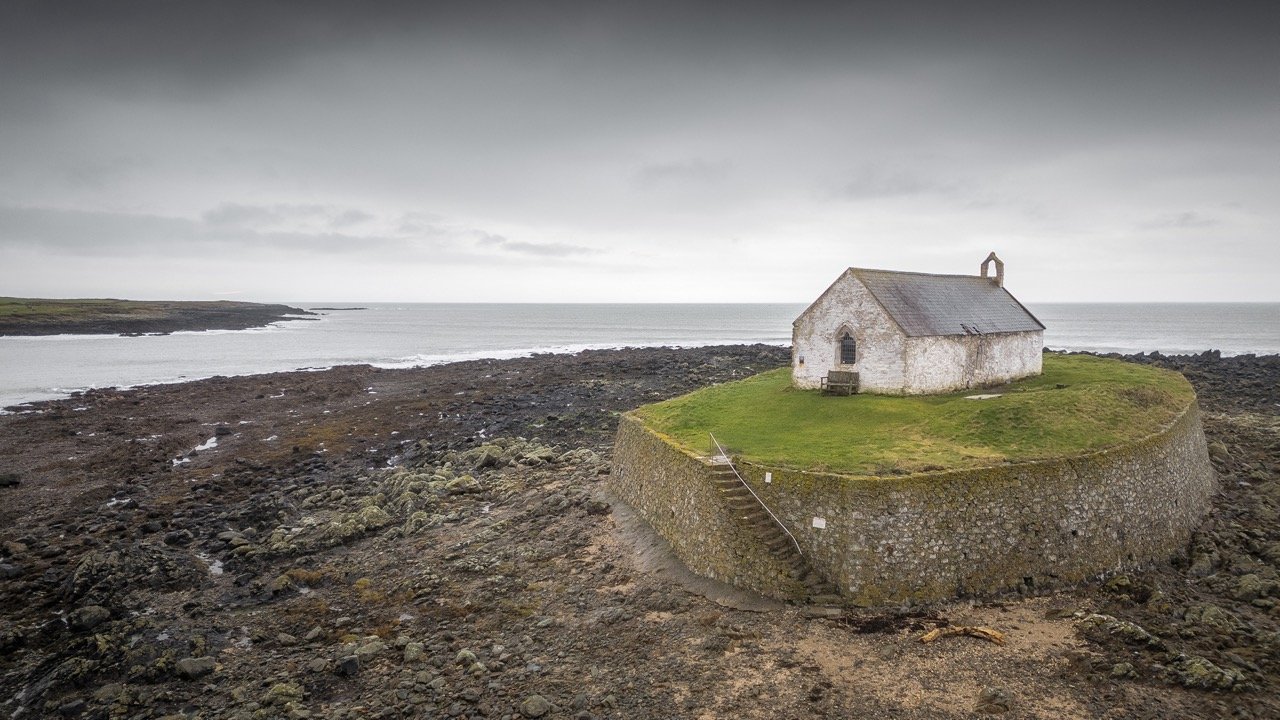
Cwyfan Church, often known as the Church in the Sea, is one of the most striking locations for landscape photography in Anglesey. Sitting just off the shoreline on a small tidal island, it’s the kind of subject that immediately catches your eye. On this visit to North Wales, I wanted to photograph Cwyfan Church, but I also wanted to slow down and respond to the wider coastline rather than rush straight into the most obvious composition.
That’s often the challenge with landscape photography. A strong subject can take over your thinking very quickly. In this case, the Church in the Sea had such a strong presence that it would have been easy to ignore everything else around it. But this stretch of coast offered much more than the church alone. There were heavy waves rolling in from the Irish Sea, dark rocks full of texture, and several different viewpoints that changed the feel of the location completely.
Starting with the coastline
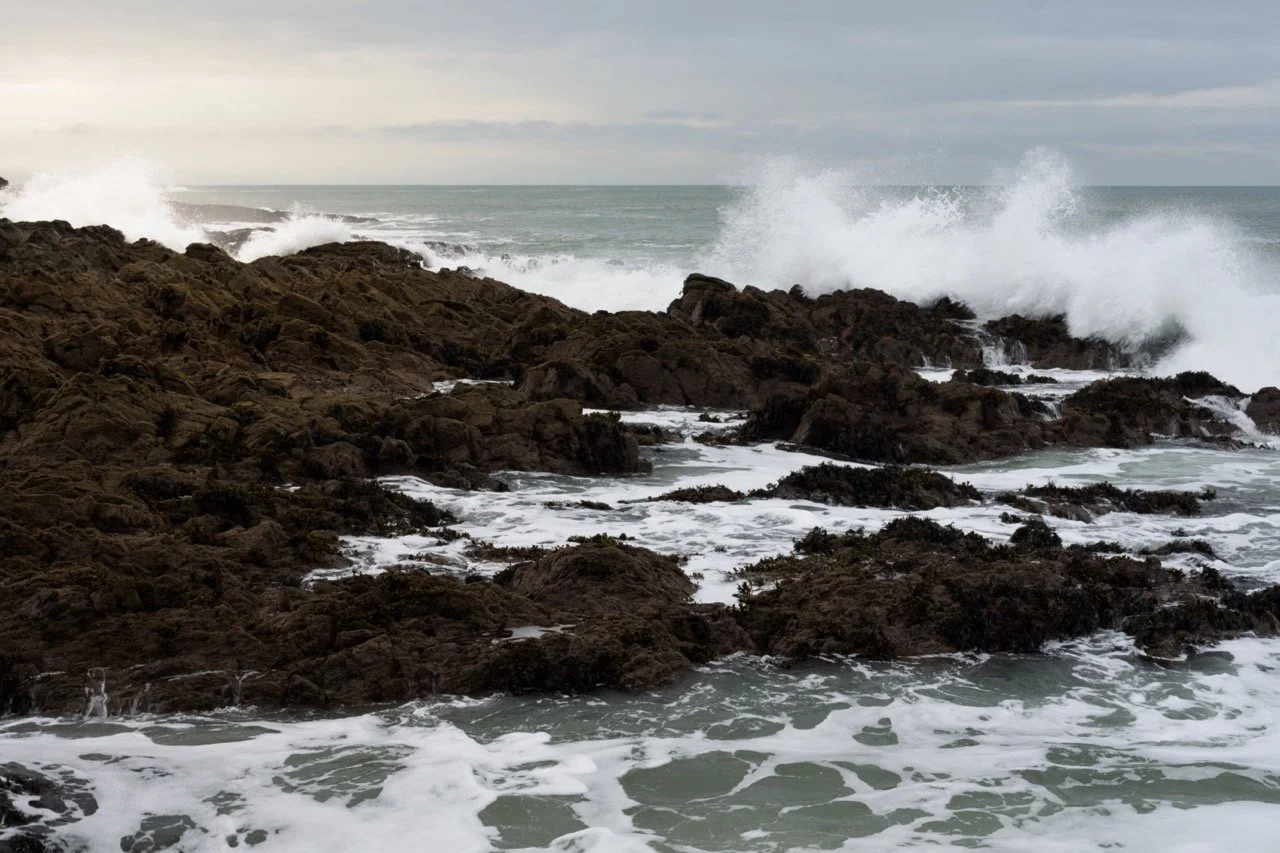
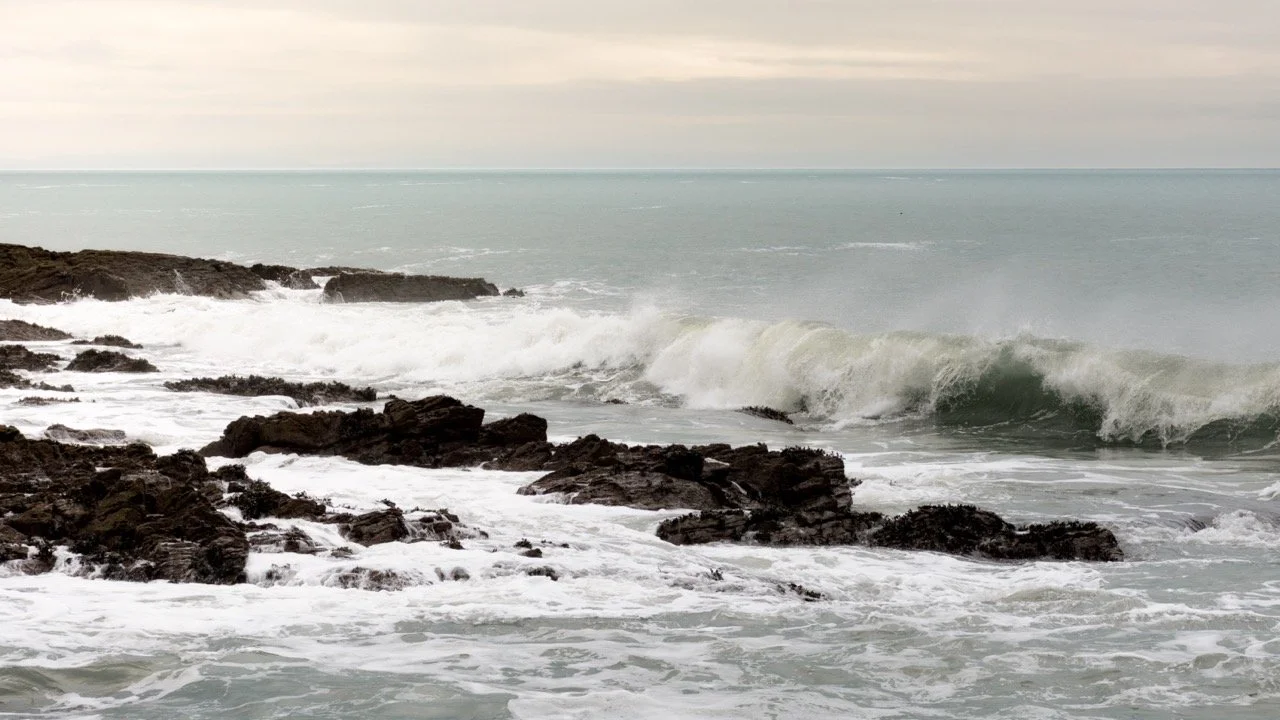
Before focusing fully on Cwyfan Church, I moved further around the coast where the sea was crashing hard into the rocks. For me, this was one of the most enjoyable parts of the morning. The light was soft and fairly flat, but the conditions still felt full of energy. That is something I often find with seascape photography. You don’t always need dramatic sunlight for the scene to work. Movement, shape and atmosphere can carry the image on their own.
I kept the compositions simple and tried to make the photographs all about the force of the sea and the timing of each wave. Every wave was different. Some had a beautiful line just before impact, while others exploded into the rocks and sent spray into the air. I worked with a remote shutter and experimented with a few shutter speeds, trying to decide whether I preferred a slightly softer feel or a faster exposure that held more of the shape.
In the end, the quicker shutter speeds suited this part of the Anglesey coast better. They seemed to capture the force of the water more honestly. It reminded me how much I enjoy this kind of coastal photography in North Wales when the sea is lively and unpredictable.
Turning back towards the Church in the Sea
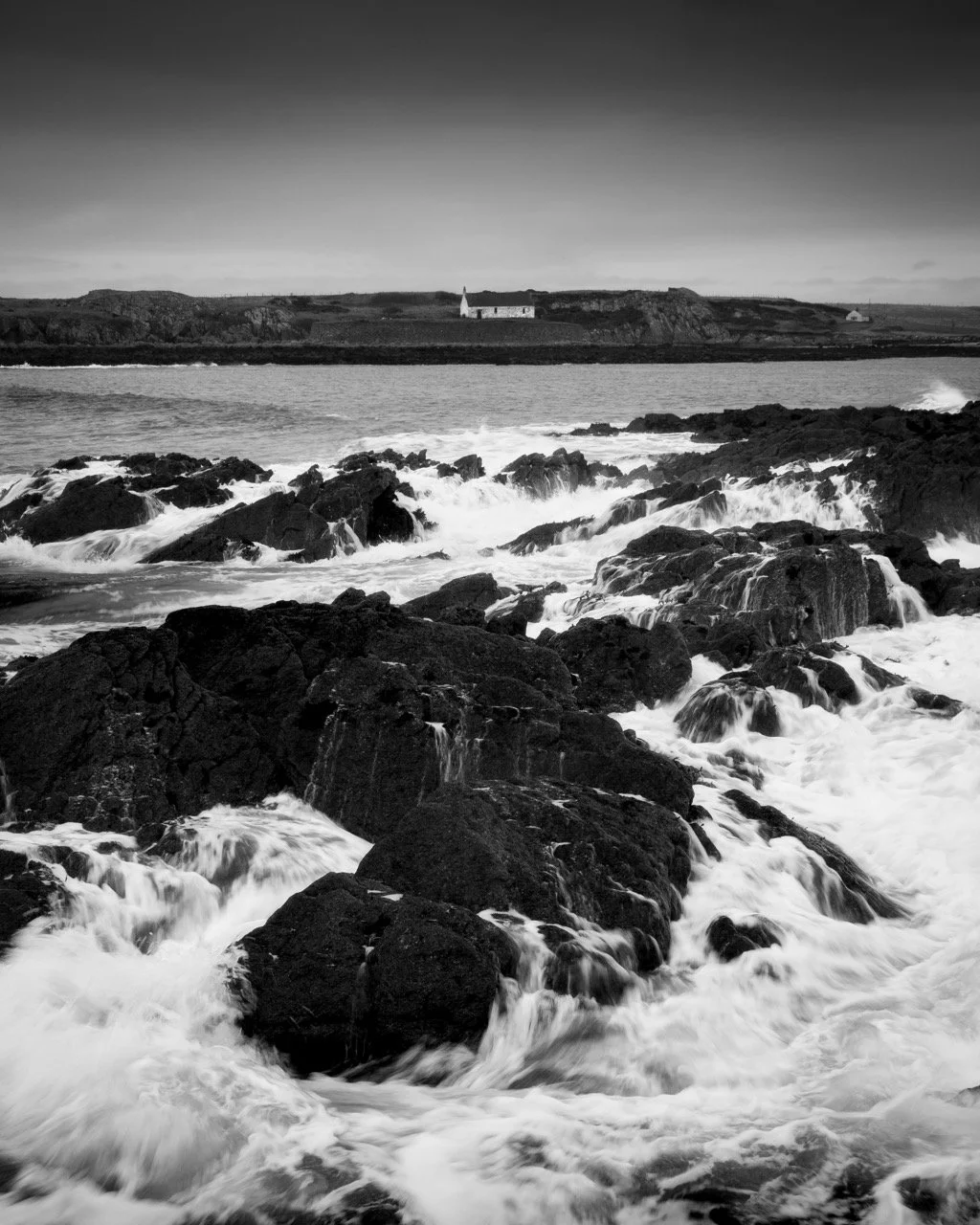
After spending time with the waves, I turned my attention back to Cwyfan Church. The water was still crashing over the rocks in front of me, and I wanted to carry some of that movement into the frame. Photographing Cwyfan Church from this position was not straightforward. There was a lot happening in the foreground, and the scene felt busy. The colour was not doing much either, partly because the light remained flat and subdued.
That’s why I decided to process one of the images in black and white. Black and white coastal photography can work especially well when colour is not adding much to the frame. In this case, removing the colour made it easier to simplify the scene and focus on the shapes of the rocks, the movement of the water, and the isolated presence of the church itself.
For me, that monochrome image says more about the mood of the morning than a colour version would have done. It feels quieter, more graphic, and more in keeping with the weather and the sea.
A different viewpoint of Cwyfan Church
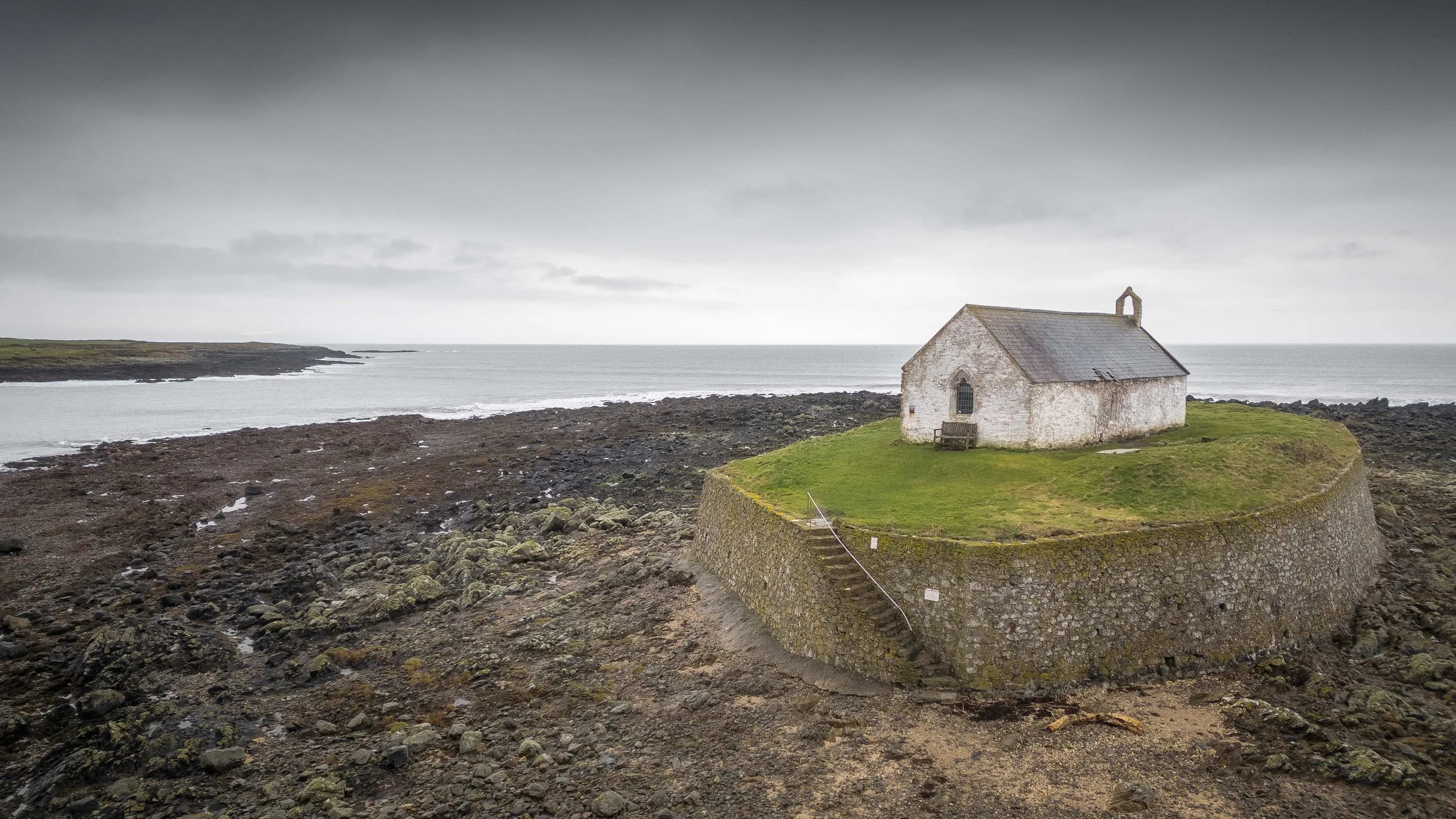
As I moved further around the shore, I found myself much closer to the church and looking at it from a completely different angle. This is one of the things I enjoy most about landscape photography in Anglesey. Even a well known subject can shift dramatically depending on how you approach it. Cwyfan Church is photographed often, and for good reason, but there is still real value in walking the coastline and letting the subject reveal itself slowly.
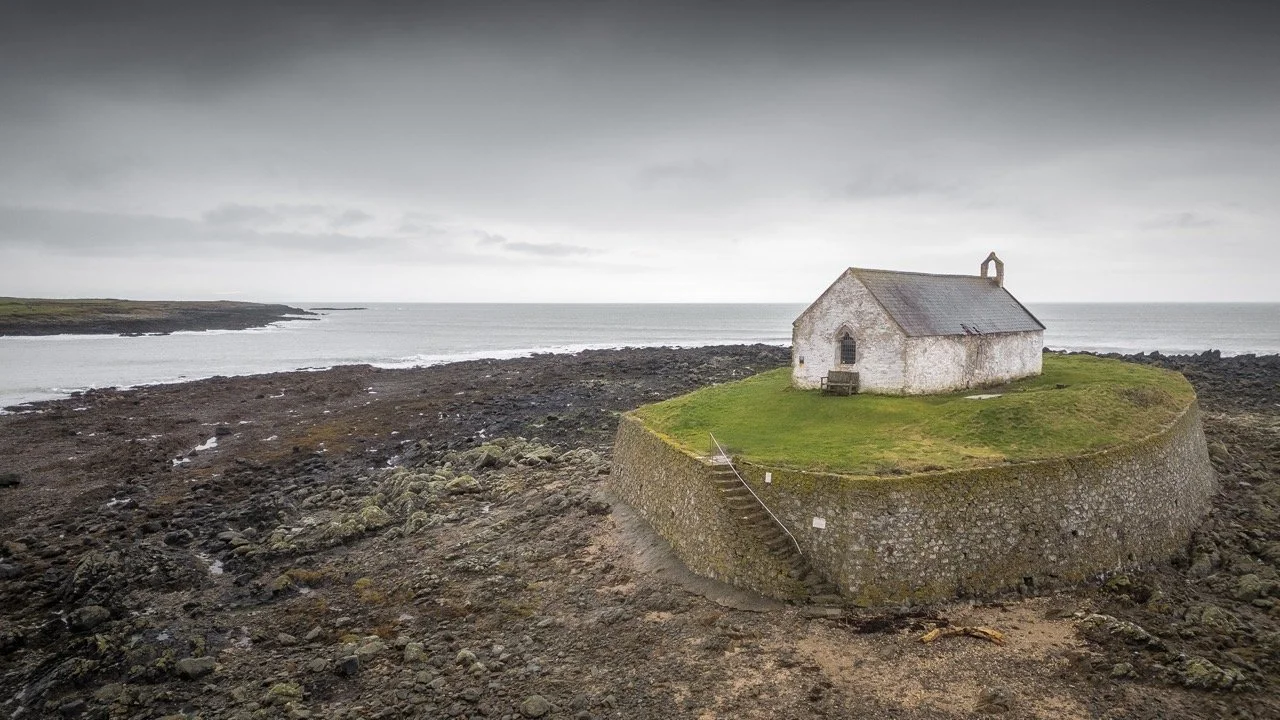
From this more elevated viewpoint, the church felt stronger and more self-contained. I sent the drone up to see if I could make a straighter, cleaner image of the building on its tidal island. The light was still not especially dramatic, but the subject itself is so powerful that the final image still worked well. The isolation of the church, the shape of the enclosing wall, and the surrounding sea and rocks all combined into a very simple photograph.
This kind of coastal photography does not always rely on spectacular conditions. Sometimes the subject carries the image, and the job is simply to make the cleanest composition possible.
Looking beyond the obvious photograph
Once I felt I’d made the classic image of the Church in the Sea, I started to explore a little more freely. This is often when a location becomes most interesting. The pressure to get the obvious shot has gone, and you can start paying attention to smaller details and quieter compositions.
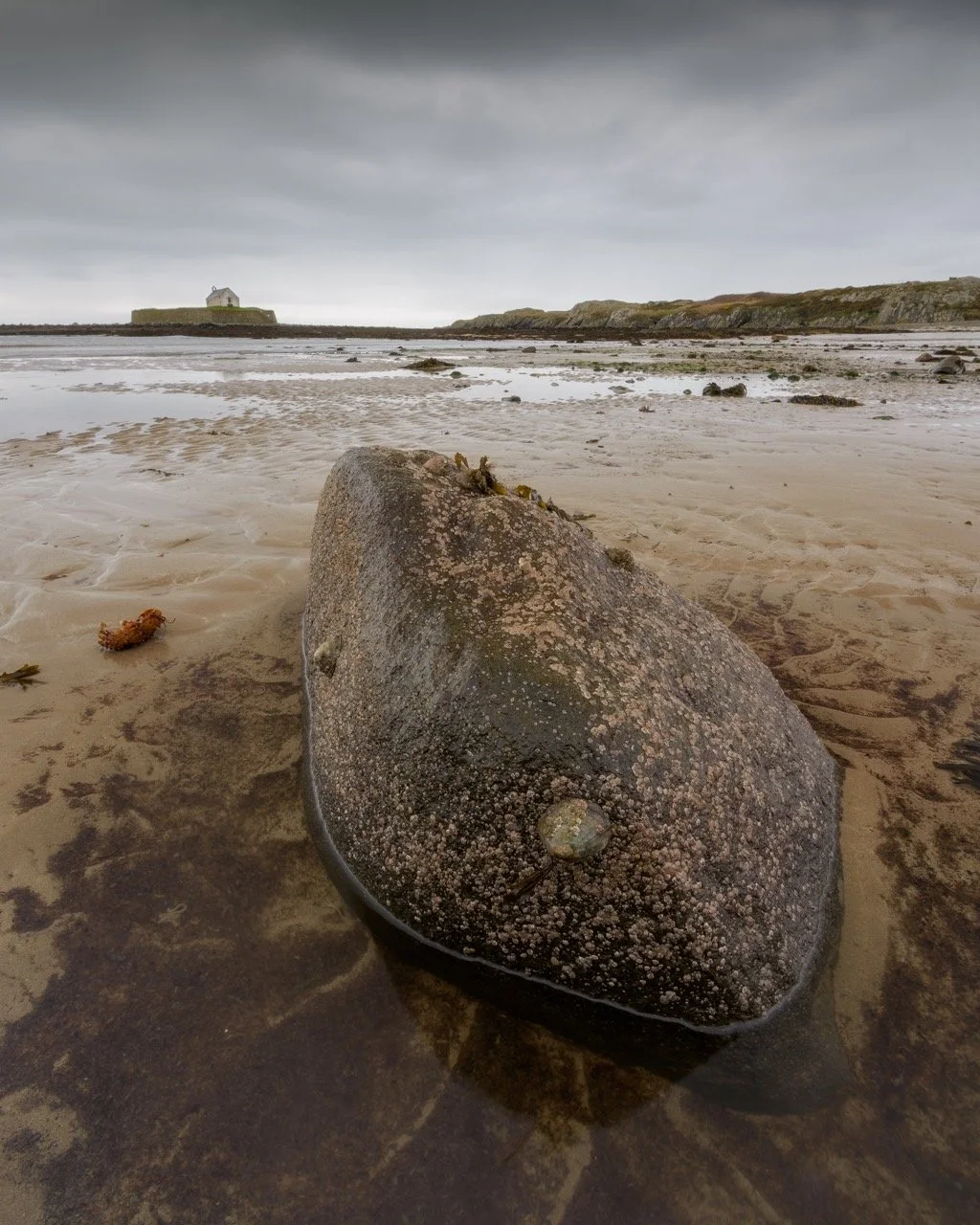
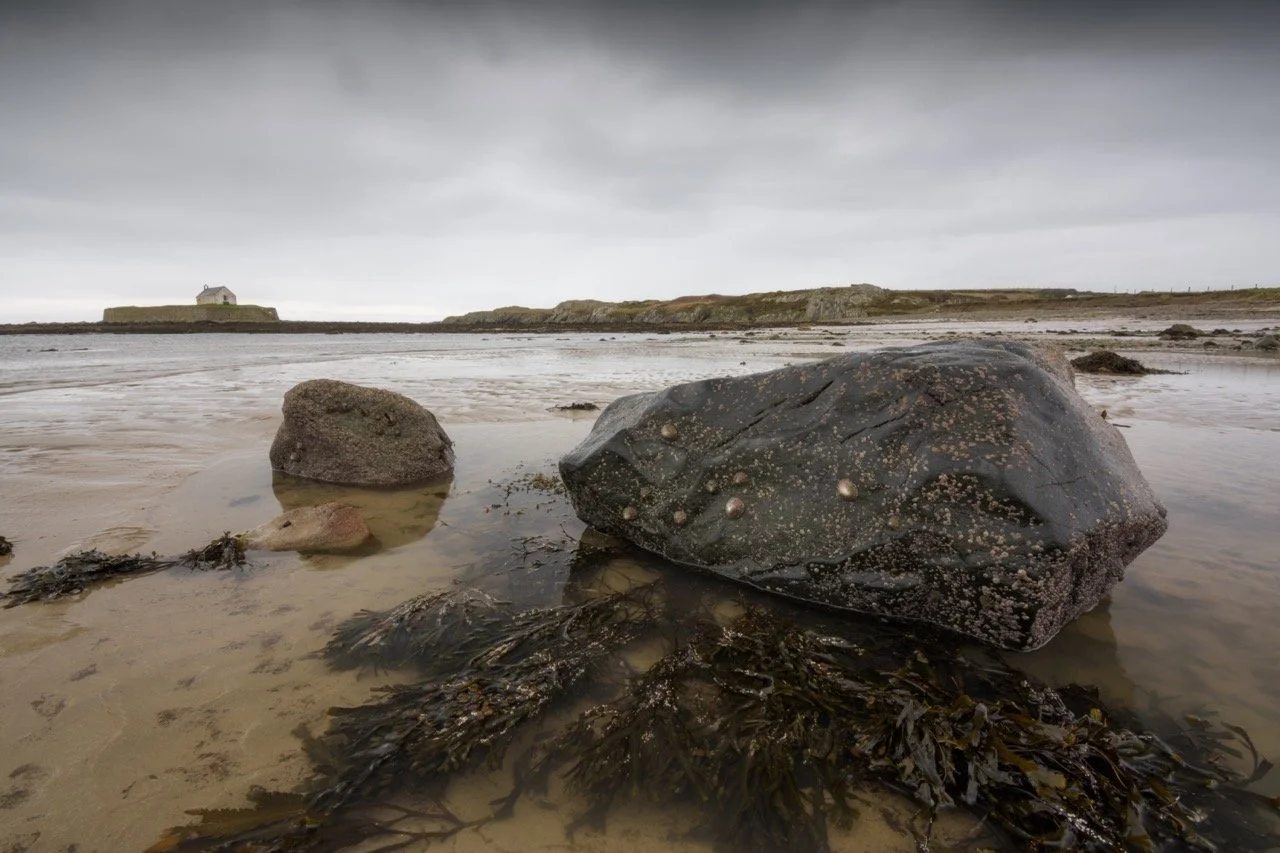
With a wide angle lens, I worked with some of the textured rocks closer to the camera and let Cwyfan Church sit further back in the frame. These rocks had so much detail and character that they felt worth building a photograph around. I stopped down to keep the foreground sharp and focused carefully on the rocks themselves. If there was a slight fall-off towards the church in the distance, that didn’t bother me too much. What mattered was holding the structure and texture in the foreground.
This is one of the reasons I enjoy photographing coastal locations like this. Even when the main subject is obvious, there are still smaller compositions waiting nearby. That feels especially true with landscape photography in North Wales, where weather, texture and distance can all work together in subtle ways.
Soft light still has something to offer
One of the more useful reminders from this visit was that not every good day for photography looks dramatic at first glance. There was no golden sunrise, no beam of light hitting the church, and no especially colourful sky. Yet there was still plenty to respond to. The clouds had gentle tonal variation, the wet sand and rock pools reflected light softly, and the sea provided constant movement.
That matters because people often arrive at a location like Cwyfan Church hoping for big light and big drama. Sometimes that happens, but often it does not. The better approach is to stay open to what the place is offering in that moment. For this visit, it was more about shape, tone, texture and the energy of the sea than about dramatic light.
Final thoughts on photographing Cwyfan Church
Cwyfan Church is an outstanding subject for landscape photography in Anglesey, but what interested me most on this visit was not just the church itself. It was the wider experience of working the coastline around it, watching the waves, trying different viewpoints, and responding to the quieter conditions as they were.
Photographing Cwyfan Church is not only about standing in the obvious spot and taking the obvious frame. It is also about exploring the shore, noticing how the foreground changes, seeing how the weather shapes the mood, and staying open to black and white, drone work, or smaller details in the landscape. That is what made this visit rewarding for me.
If you are interested in landscape photography in Anglesey, or more generally in coastal photography in North Wales, Cwyfan Church is a location well worth slowing down for.
If you'd like more practical photography tips, you can download my free guide to getting consistently sharp photographs HERE.
If you'd like to see the full shoot and the behind the scenes of photographing Cwyfan Church on the Anglesey coast, you can watch the video below.
Popular posts:


Free Photography eBook
Free access to my downloadable (pdf) tutorial on how to get pin-sharp images.
New / Noteworthy

Photographing Rannoch Moor in Glencoe, Scotland. Exploring dramatic winter light, lochans, foreground compositions and atmospheric mountain landscapes beneath Buachaille Etive Mòr.